UNDER CONSTRUCTION
Ivanovo (formerly Ivanovo-Voznesensk) is industrial town located at about 300 km to the North-East from Moscow, specially famous for its textile factories. In addition to two Universities, there is the Institute of Solution Chemistry belonging to Academy of Sciences. The starting poind of scientific development in Ivanovo was WWI, when the town was selected for evacuation of Riga Polytechnical Institute.
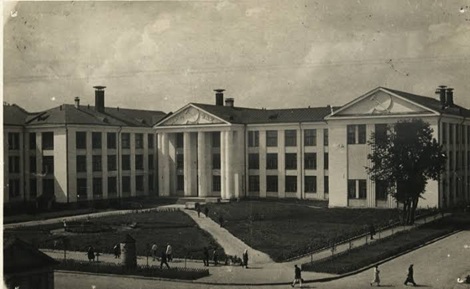
Polytechnical University <or Institute, later known as Ivanovo Chemical-Technological Institute (ИХТИ)> was established in 1918, after four years of discussions about the fate of its parent institution evacuated from Latvia, which partly returned to Riga in the same year.
Two former students of E.I.Spitalskyi joined this new institute in 1919: Arkadyi Vladimirovich Pamfilov (1893-1985), 1916 graduate, and Evgenyi Alekseevich Shilov (1893-1970), 1917 graduate. Both finally found themselves in Ukraine. Here are the examples of very early study of chromium deposition from Cr(III) bath in Ivanovo:
Shilov E.A. On the reform of Russian chemical nomenclature // Uspekhi Khimii. 1933. V. 2. P. 760-763, in Russian. Presentation of suggestions worked out by special Ivanovo commission for discussion at Mendeleyev Meeting.
A link between Ivanovo and Moscow University was formed by the lectures of I.A. Kablukov in 1918-1920, he visited Ivanovo every week.
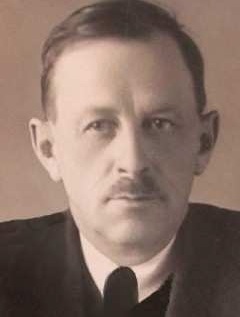
Leonid Leonidovich Kuz’min (1904-1998) organized the Dept of Electrochemical Engineering in Ivanovo Polytechnical Institute in 1937, and headed it for about three decades. His main research direction was related to alkaline batteries (1951 DSc thesis), and later he started with plating as well, including metallization of dielectric materials. Graduates of Kuz’min’s Department greatly contributed to creation of Depts of Electrochemical Engineering <кафедры технологии электрохимических производств, ТЭП> in various places in USSR. There is a touching book published in Ivanovo in 2014 (Kuzmin’s 110 jubilee), collecting various memorial texts. Here is a list of his graduates and complete list of publications extracted from this book <in Russian>.
Among electrochemists working at Kuz’min’s Dept for some periods, we should mention V.P. Mashovets (came from Kiev, then left for Leningrad), M.A. Loshkarev (came from Ural, then left for Dnepropetrovsk), and I.G. Shcherbakov (came from Ural, headed the Dept in 1946-1949, then left for Nizhnii Novgorod). In July 1945, Ivanovo hosted the first All-Union Conference on electrochemistry.
During “industrialization” period (early 1930s), experimental metallurgical plant “Komprovosstal’” was built in Ivanovo. The project assumed, in particular, the production of sponge iron by “direct reduction” (at relatively low temperatures, to avoid melting and corresponding contamination). This technology was developed by Leon Ottovich Trautman, german engineer, whose fate is unknown (most probably sad). We found a small publication affiliated with this plant, on electrolysis with mercury electrode (Zavodskaya Laboratoriya. 1939. V. 8. P. 327). There are no any hypotheses about motivation of this work. The name of the author, Nikolay Ivanovich Stognyi, can be later found in Dnipro, where he defended PhD thesis in 1953 (non-electrochemical topic).
Currently Ivanovo is specifically known for solution research, and supports specialized academic Institute of Solution Chemistry (established in 1981, named initially the Institute of Chemistry of Nonaqueous solutions). One can assume that solvation research in this city originates from the period of 1919-1931, when Ya.K. Syrkin worked in the Polytechnical Institute (see in Koifman’s article, in Russian). After WWII, various contributions to solution chemistry (mostly coordination chemistry) in Ivanovo belonged to K.B. Yatsimirskyi (1916-2005), the pupil of M.I. Usanovich, to I.L. Krupatkin and to several graduates of Ivanovo Polytechnical Institute mentioned below.
Ilya L’vovich Krupatkin (1915-1997) worked on miscibility of liquids and non-ideal mixtures of solvents. After graduation from Perm University, he worked at chemical plants, and also spent 5+ years in the army. His PhD thesis (1949) was completed in parallel with industrial work and addressed phase equilibria in the systems related to polymers production. His further employments included (chronologically) Pedagogical Institute in Cherkasy (Ukraine), the period 1957-1966 in Ivanovo as a head of inorganic chemistry Dept, and longer period in Tver’ <Kalinin>. In Tver’, large enough city located 180 km from Moscow, he worked subsequently in Pedagogical Institute and in local University. Many details can be found in the text dedicated to his century (in Russian).
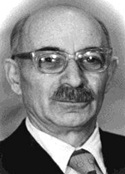
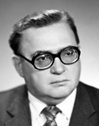
Gennadyi Alekseyevich Krestov (1931-1994), whose name is given to the Institute of Solition chemistry, developed the concept of solvation, combining thermodynamic approaches and models for molecular interactions <link goes to memorial text in Russian>. He was Krupatkin’s successor at the Dept, and payed special attention to nonaqueous solutions of non-electrolytes. His book “Thermodynamics of Solvation, Solution and Dissolution; Ions and Solvents; Structure and Energetics” was published as a part of Ellis Horwood Series in Physical Chemistry in 1991. English translation of another book “From crustal to solution” (1980), co-authored with V.A. Kobenin, is available at archive.org.
Boris Dmitrievich Ber<y>ezin (1929-2012) started his research under supervision of K.B. Yatsimirskyi, dealing with solution сhemistry of mercury in the context of titrimetric analysis (1955 PhD thesis). Then he started his most known studies of phtalocyanine-metal ions complexation (1966 DSc thesis), and this appeared to be a famous Ivanovo topic for decades. Berezin’s book “Coordination Compounds of Porphyrins and Phthalocyanines was published by Wiley in 1981. Many details can be found in Koifman’s 2009 article (in Russian).
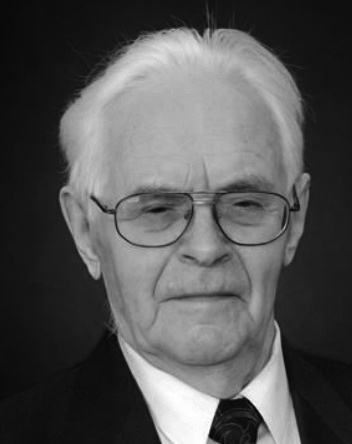
Yatsimirskyi/Berezin research branch formally belonged to analytical chemistry. Here is Yatsimirskyi’s article on the history of analytical chemistry in Russia: Uspekhi Khimii. 1949. V. 18. P. 623-628, in Russian.
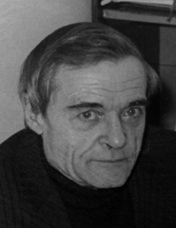
Yury Mikhailovich Kessler (1924-2002) moved to specialized institute in Ivanovo in 1980s, and devoted himself to development of the models of solvation phenomena. Earlier he worked on nonaqueous electrolyte solutions in Moscow: in Frumkin Institute (this solution research was important for lithium battery topic), in the Institute of Inorganic and General Chemistry, and finally in the Institute of chemical machinery (МИХМ).
Oskar Iosifovich Koifman (1944-2023), Berezin’s follower, extended the studies of various macroheterocycles essentially beyond solution chemistry. He also played very important role in keeping scientific history of Ivanovo, by writing various texts himself and editing other publications based on local archives. Here is obituary and introductory text from memorial special issue.
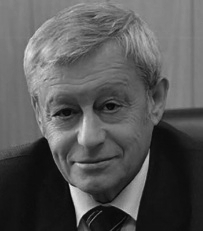
Sergey Anatol’evich Lilin, who completed his PhD thesis in 1972 in Frimkin Institute (ionic adsorption on nickel) worked in Ivanovo during all his career. In 2001, he defended DSc thesis on anodic treatment of metals in aqueous-organic solutions.