Lviv University developed as a Jesuits educational institution for a long time, and started to transform into University at the end of XXI century.
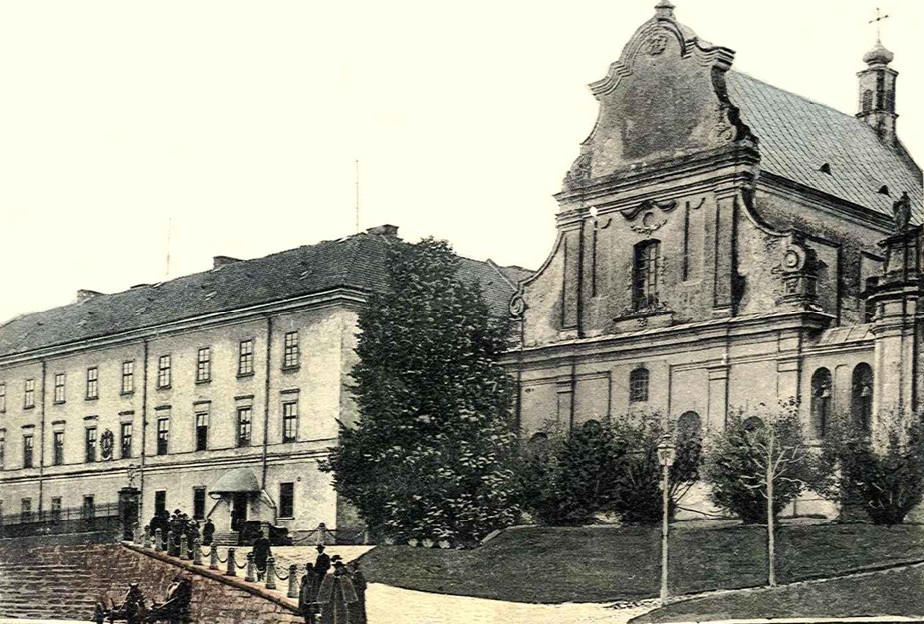
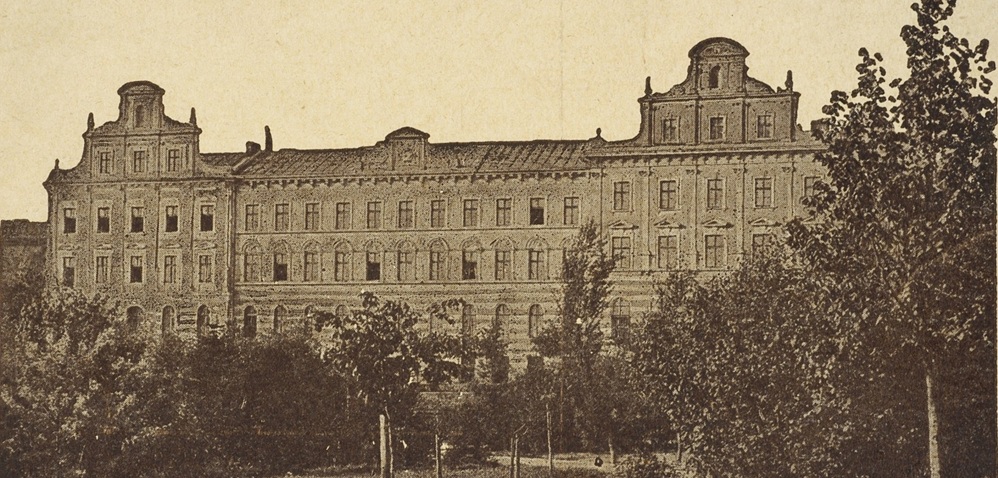
The roots of Lviv Polytechnica are associated with Technical School (1816) and Technical Academy (1844).
Kazimierz Z<S>ygmunt Idaszewski (1878 – 1965) is the first person associated with electrochemistry in Lviv Polytechnica. He was Polish electrical engineer, whose doctoral thesis adressed electrolytic action on copper sulfide and was published in Z. Elektrochem. 1905. Bd. 11. S. 161-182. His systematic activities in Lviv (1920-1939) were mostly related to electrical measurements. After WWII, he moved to Krakow, and then to Wroclaw.
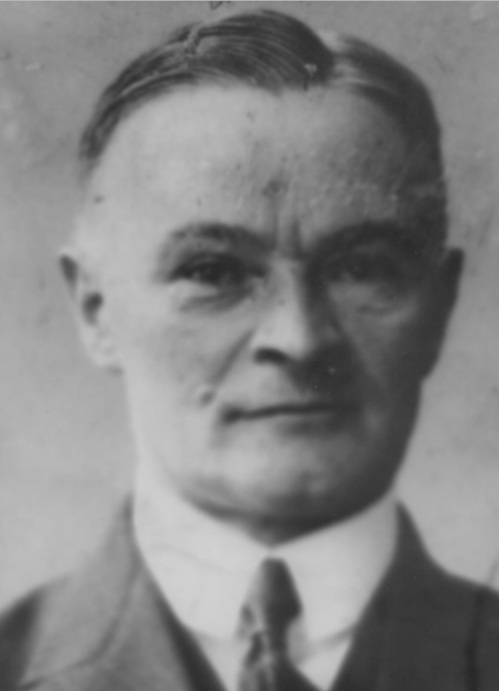
Sergey Pavlovich Miskidzh’yan (1910-1985) was affiliated with Lviv Medical Institute. He worked subsequently on electrolyte solutions, on polarography of organic substances (related to pharmacy), and on corrosion inhibition. He graduated from Rostov-on-Don University in 1937, and completed his PhD thesis on the mixtures of nitric and acetic acids in the same place in 1945. His 1964 DSc thesis, completed in Lviv and defended in Kiev, inherited Plotnikov’s ideas of electric conductivity in solutions formed from non-conducting components.
Ig<h>or Rafailovich Yukhnovskyi (1925-2024) graduated from Lviv University in 1951, being at the front of WWII before starting his education. He was theoretical physicist internationally recognized for development of microscopic theory of electrolyte solutions in 1960s. In addition to Dept in Lviv University, Lviv division of the Bogolyubov Institute for Theoretical Physics was established in 1969, which is now named Yukhnovskii Institute for Condensed Matter Physics and supports relative research directions. Regardless of science, Ihor Yukhnovskyi made a lot for Ukrainian independence and development of political institutions in the country. Condemning the war resolutely, he stressed the role of science and education for technological progress in Ukraine, being decisive to resist Russian aggression.
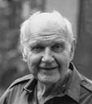
Corrosion branch of L’viv electrochemistry is affiliated with Karpenko Physical-Mechanical Institute. In 1960s, mechano-electrochemical concepts were elaborated by Emmanuil Markovich Gutman [Emmanuel Gutman], who started in L’viv after completing his 1962 PhD thesis in Dnipro, where he studied underground corrosion affected by the leakage current from electric locomotives. As we can judge from very early publication (Industrial Laboratory. 1959. V, 25. P. 507), this work included the study of electroosmosis in porous soils at elevated pressure. Gutman’s work on deformation-affected corrosion (1970 DSc thesis) was continued when he moved to Russia in 1970s (e.g., deformation effect on pitting corrosion of steel, Protection of Metals. 1977. V. 13. P. 494-496). Finally, he moved to Izrael in 1990s, where he was affiliated with Ben Gurion University in Beer-Sheva, and completed well-known book “Mechanochemistry of Solid Surfaces”, World Scientific, 1994. His basic works of 1960s were published in Fizikokhimicheskaya Mekhanika Materialov (FKhMM), which translated version (sometimes published with ca. one year delay) is named Soviet Materials Science.
Gutman E.M. Thermodynamics of the mechanico-chemical effect – I. Derivation of basic equations. Nature of the effect // Sov. Mater. Sci. 1968. V. 3. P. 190-196. Russian version: FKhMM. 1967. V. 3. P. 264-272.
Gutman E.M. Thermodynamics of the mechanico-chemical effect – II. The range of operation of nonlinear laws // Sov. Mater. Sci. 1967. V. 3. P. 293-297. Russian version: FKhMM. 1967. V. 3. P. 404-410.
Gutman E.M. Interdependence of corrosion phenomena and mechanical factors acting on metals // Sov. Mater. Sci. 1968. V. 3. P. 401-409. Russian version: FKhMM. 1967. V. 3. P. 548-559.
Gutman E.M. Kinetics of anodic and cathodic reactions of deformed steel in acid electrolytes // Sov. Mater. Sci. 1969. V. 4. P. 63-65. Russian version: FKhMM. 1968. V. 4. P. 87-88.
Gutman E.M., Petrov L.N., Karpenko G.V. Effect of deformation on electrochemical properties of the double layer and surface charge of metals // Sov. Mater. Sci. 1969. V. 4. P. 105-110. Russian version: FKhMM. 1968. V. 4. P. 149-156.