Kharkiv is a large industrial and intellectual city in Ukraine. It is specially famous for development of physics in 1920s-1930s, associated with the names of Lev Landau, Lev Shubnikov,….


Kharkiv University was established in 1803, and it was the first University in Russian Impire (or, probably, even in the world) where teaching of physical chemistry as an independent discipline was started in 1860s, due to outstanding efforts of Nikolay N. Beketov (1827-1911), who worked in Kharkiv in 1855-1887. He developed first as synthetic chemist, but his most known original research was related to “metal substitution” redox reactions. The article from Uspekhi Khimii. 1948. V. 17. P. 132-143 (in Russian) suffers from rediculous Russian patriotism, but presents a lot of information about Beketov’s research and life. More balanced article, containing a list of publications, was published by N.A. Izmailov in Uspekhi Khimii. 1952. V. 21. P. 996-1011 (in Russian).
The most deep layers of electrochemical history can be found in 2004 article of Nikolay O. Mchedlov-Petrossyan (Vestnik Kharkiv Nat. Univ. 2004. N 626. Chemistry. Issue 11(34), in Russian). This excellent article addresses chemistry in Kharkiv Univ as a whole; we marked yellow the fragments and names related to earliest physical chemistry and to electrochemistry/solution research, and present some faces and names below. We also collect representative articles related to solution research in USSR at a separate page, which is attached to Kharkiv page because of the unique role of this city in the early development of this field.

Vasilyi Ivanovich Lapshin (1809-1888) studied electrochemical decomposition of organic substances and inorganic melts (oxides, sulfides) using a battery of hundreds of Bunsen-like cells (amalgamated Zn and carbon electrodes; chromic or nitric acid). His 1859 observations are described (in Russian) in Vestnik Estestvennykh Nauk (Herald of Natural Sciences), published by the Imperial Moscow Society of Naturalists. 1860. V. 7. Issue 37/38. P. 1159-1182; Issue 39. P. 1223-1229. This text is of interest in respect to heat generation and arc switching in electrolytic cell, and is also considered as very early contribution to melt electrochemistry. Here is biographic text in Ukrainian.
Vladimir Fedorovich Timofeyev (1858-1923)


Pavel Dmitrievich Khrushchev (1849-1909)
Gavriil Efimovich Tomofeyev (1881-1926)

Arkadyi Efimovich <Yukhimovich> Lutskyi (1905-1980), 1930 graduate of Kiev Polytechnical Institute, worked in Kharkiv Polytechnical Institute starting from 1937. He headed the Dept of physical chemistry in 1961-1980. His research of liquids (incl. organic solvents) accented molecular aspects, particularly, the role of hydrogen bond. This included molecular spectroscopy, electrooptical experiments, and quantum chemistry.
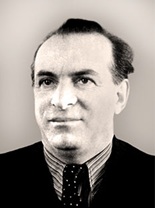

Nikolay Arkadievich Izmailov (1907-1961) was a promonent expert in solutions research, and authored a fundamental monograph in this field. A number of his articles can be found in our ‘Solution research’ and ‘Glass electrode’ collections. There is also his advancement related to chromatography. A brief description of his findings can be found in this 50th jubilee article (1958), in Russian.
Comprehensive centenary description of Izmailov’s research, with complete list of his publications. Modified English version with selection of articles was published in J. Mol. Liquids. 2009. V. 145. P. 110-115. More brief text in English can be found in Pure Appl. Chem. 2008. V. 80. P. v-vi.
The memoir of his daughter, Viktoriya N. Izmailova (1930-2002), is available in Russian. She was professor of colloid chemistry in Moscow University, and devoted friend of Frumkin school.
Vasiliy Danilovich Bezuglyi (1922-2001), 1946 graduate of Kharkiv University and pupil of N.A. Izmailov, is mostly known for his polarographic research concentrated on analysis of polymers. An example of his conference review is available in our polarographic collection. He was also active with polarography in non-aqueous solutions, and addressed electrosynthesis of polymers in some works. In 1950s, he was affiliated with pharmaceutical plant, then with the Institute of Single Crystals, and finally moved to extramural Polytechnical Institute in 1968.
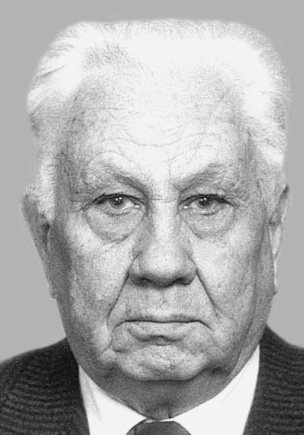
Boris Ivanovich Bairachnyi (1935-2020) graduated from Kharkov Polytechnical Institute,and spent almost all his life there. His 1968 PhD thesis addressed iron electrode for batteries. Later he moved to anodization of metals (1985 DSc thesis, Al, Nb, Ti, and Ta).
P.A. Rebinder visited Kharkov in 1956 to presented a course of lectures “The new problems of colloid chemistry” (chronicle note, in Russian).