Among various dark periods for work and life in the USSR, “anti-cosmopolitant” period (started in 1946) was of special danger for intellectuals, and had an evident anti-semitic smell (ca. 70% accused of cosmopolitanism were jews). This terrible story is documented not only in newspapers, but also in scientific journals because the attacks had, in particular, a form of “scientific discussions”. We collect below original full-text articles related to such discussions, in a hope that any future investigators, or interested colleagues of younger generations, will use these primary sources. Be prepared to texts in Russian, as during this period only very few translations were published.
In 1920-1930s, nothing seemed to anticipate the fight with “foreign influence”. Contrary, there was a trend to publish Russian journals in foreign languages. It was surely assumed that soviet scientists should read foreign professional litearture: What foreign language is primarily required for soviet chemist // Uspekhi Khimii. 1940. V. 9. P. 589-595, in Russian. <This interesting bibliometric analysis is authored by Al’fred Feliksovich Plate (1906-1984), organic and oil chemist, who concluded that the preferences are as follows: German > English > French.>
The first signatures of “anti-cosmopolitant” attack could be noticed during WWII: soviet propaganda started to accent the predominating role of Russia in various spheres, giving rise to well-known unfunny joke “Russia is a birthplace of elephants”. Here is an example of such propaganda related to science: Zaslavskyi I.I. The role of Russian scientists in creation of world chemistry // Uspekhi Khimii. 1944. V. 13. P. 328-335. <Later this author, crystal chemist from Ivanovo, was anounced cosmopolitant himself.> The prelude to future campaign was 1944 “fight of science from Universities and from Academy”. The former were represented by “patriots of soviet/Russian science”, mostly professors of Moscow University, attacking a group of famous academicians (including A.F. Ioffe, P.L. Kapitsa, N.N. Semenov, A.N. Frumkin, L.I. Mandel’shtam). This attack was arranged in the form of denunciations sent to the central committee of the comunist party. The fraudsters were finally not successful, simply because people from Academy played dominating role in atomic project. However, the subsequent events demonstrated that protection by participation in this project is less reliable.
Unfortunately, N.I. Kobozev was one of the performers of this prelude. Another one was Nikolay Sergeyevich Akulov (1900-1976), solid state physicist, who decided to contribute to chemical kinetics before WWII, and was strongly offended by professional discussion of his mistakes at March 1941 session (Izvestiya Akademii Nauk SSSR. 1941. No 4-5. P. 629-633). The text is compelled by Oskar Moiseevich Todes (1911-1989), Roginskyi’s collaborator. All participants of this discussion, including Semenov, Frumkin, and Temkin, became Akulov’s enemies. The names other performers can be found in well documented book of Anatolyi Stepanovich Sonin (in Russian), which covers a period of about decade.
“Patriotic” propaganda was also based on attracting attention to the public actions of Russian scientists in the past: Pogodin S.A. Stand of Russian chemists N.N. Zinin, A.M. Butlerov, D.I. Mendeleyev, and A.N. Engelgardt against nationalism and chauvinism in science // Uspekhi Khimii. 1946. V. 15. P. 633-643 (about the document of 1870, having a strong anti-German taste).
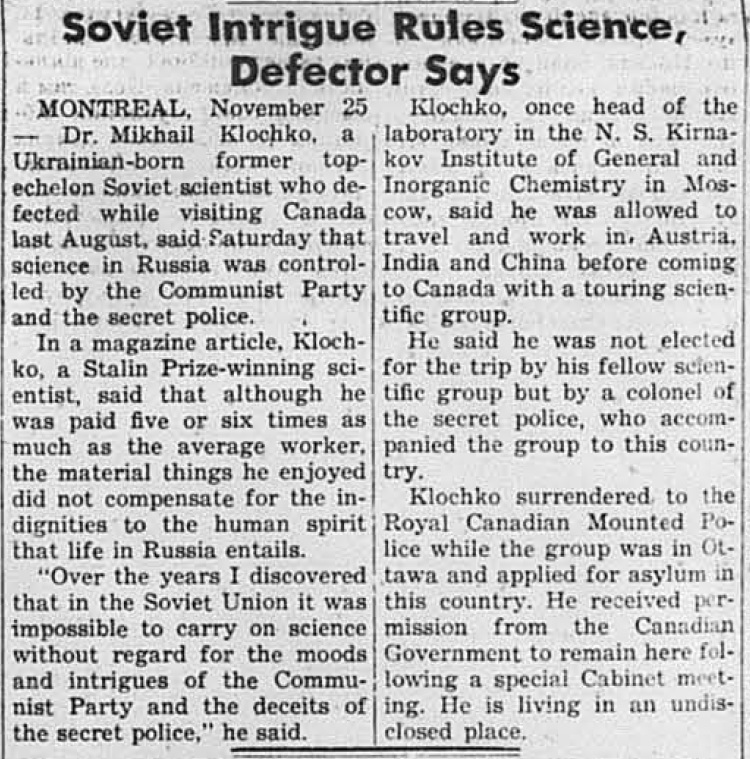
Ya.K. Syrkin and A.N. Frumkin were first attacked personally under the pretense that their joint 1936 article “Physical Chemistry” published in the Great Soviet Encyclopedia was not “patriotic” enough (role of Russian scientist was allegedly underestimated). One can see how this role was presented in 1948 and in 1952 (even by more or less reasonable authors). An example of direct attack in May, 1948 is the article “On the history of physical chemistry in Russia in XIX century” in Proceedings of the 1st All-Union meeting on the history of chemistry, P. 30-36. The author is Mikhail Antonovich Klochko <Bendetskyi> (1902-1986), who worked with V.A. Plotnikov in Kiev up to 1930s, then with N.S. Kurnakov in Leningrad and Moscow, and finally defected in 1961 when visited Canada (clipping from “Svoboda. Ukrainian Daily” newspaper N 230, Dec 2, 1961). This custom-made article contains a list of Russian publications, which is assumed to show that physical chemistry was created in Russia in the mid of XVIII century. In 1948, S.Z. Roginskyi was attacked, whose works on statistical theory of catalysis were far ahead of straightforward contributions of attacking “soviet scientists”. He was suspended from atomic project, in which he played a crucial role in respect to development of isotope technologies.
A wide specialized compaign against Syrkin and his closest collaborator Mirra Efimovna Dyatkina (1915-1972) started earlier than similar compaigns in electrochemistry and catalysis, and was formally based on SyrkinpDyatkina commitment to “resonance theory”. They were attacked by usual “patriots”, who were simply proud by “Russian contribution” associated with A.M. Butlerov and other synthetic chemists, but a number of deeper professionals were also involved. “Discussion” was accompanied by philosophic arguments systematically, in a spirit of intolerance typical for “marxism-leninism”.
Syrkin and Dyatkina were inspired by approach of Linus Pauling (1901-1994) already before WWII. They arranged translation of Pauling’s 1939 book “The nature of chemical bond”, and one chapter was even published in Uspekhi Khimii. 1940. V. 9. P. 1280-1291. Jointly with A.A. Zhukhovitskyi, they also prepared the texts for university teachers to enhence distribution of new knowledge (Uspekhi Khimii. 1940. V. 9. P. 930-947 and 1038-1059) and published a large review article “Resonance in organic chemistry” in Uspekhi Khimii. 1941. V. 10. P. 121-187. Their original results related to organic molecules were first attacked during WWII, see their answer to organic chemist V.N. Ufimtsev (1903-1984) in Uspekhi Khimii. 1944. V. 13. P. 80-81.
Syrkin Ya.K., Dyatkina M.E. On the structure of complex compounds. I // Zhurnal Obshchei Khimii. 1946. V. 16. P. 345-378, in Russian. The authors state that their treatment of molecular structures is adjacent to approach of Sidgwick and Pauling, but present further development of the latter. Consider this large article as a representative example of the research of Syrkin and Dyatkina. Another example is Dyatkina’s note “Covalent justification of the Pauling’s electrostatic rule of the valency” in Zhurnal Fizicheskoi Khimii. 1946. V. 20. P.589, in Russian. There is surely nothing apologetic in respect to Pauling.
In 1946, Syrkin and Dyatkina also published a large book “Chemical bond and molecular structure”, which was very positively estimated by Aleksandr Nikolaevich Terenin (1896-1967), a prominent photochemist (Uspekhi Khimii. 1947. V. 16. P. 237-238).
In the same year, a noticeable actor of the future fight, organic <and military> chemist Gennadyi Vladimirovich Chelintsev (1905-1963) started his attacks on the resonance theory in Izvestiya Akademii Nauk SSSR. Ser. Khim. 1946. No 5. P. 549-556, in Russian, with abstract in English at the end.
In parallel, the compaign is unfolding on re-writing the history with indication of the leading role of Russian scientists. Specialized Institute of history of natural science is established, and multidisciplinary academic meeting is arranged in Dec 1946 (Chronicles in Uspekhi Khimii. 1947. V. 16. P. 235-236, in Russian). It is stated that communist/bourgeois ideological antagonism requires a systematic sharp criticism of the western literature on the history of science.
The most active attack was observed starting from 1949, and a signal for that was the article in philosopy journal: Tatevskyi V.M., Shakhparonov M.I. About one Machist theory in chemistry and its propagandists // Voprosy Filisofii. 1949. No 3(8). P. 176-192, in Russian. The authors, Vladimir Mikhailovich Tatevskyi (1914-1999) and Mikhail Ivanovich Shakhparonov (1918-2001) were not philosophers, but rather advanced experts in theoretical chemistry from Moscow University. For initial orientation in Syrkin-Dyatkina story, English-speaking readers can study the article of Loren R. Graham “A soviet marxist view of structural chemistry: The theory of resonance controversy”. Isis. 1964. V. 55. P. 20-31.
A list of original articles <incomplete> presented below attempts to keep the primary texts for future researchers, if any.
Razumovskyi V.V. Electronic organic chemistry and the routes of its development in the USSR (1917-1947) // Zhurnal Obshchei Khimii. 1947. V. 17. P. 1981-1992, in Russian. Vladimir Vladimirovich Razumovskyi (1911-?) was organic chemist pretending to the expertise in the history of chemistry. In this review with 61 Refs he collected various Russian contributions escaping any critical comments and personal attacks. He mentiones pioneering role of Abram Moiseyevich Berkenheim (1867-1938), which was positively estimated by Ya.K. Syrkin later.
Dankov P.D., Frost A.V. On the works of S.Z. Roginskyi in the area of the theory of catalysts activity // Izvestiya Akademii Nauk SSSR. 1948. No 3. P. 341-346 (Part 1) and P. 346-351 (Part 2). Here is Roginskyi’s answer (P. 351-360). All these texts are in Russian.
Sokolov N.D. On the physical grounds of the theory of chemical bond // Uspekhi Khimii. 1949. V. 18. P. 697-723, in Russian.
Chelintsev G.V. Discussion. Once again on quasicomplex compounds and hyperconjugation // Izvestiya Akademii Nauk SSSR. 1950. No 5. P. 536-540, in Russian. This is already opposed to A.N. Nesmeyanov, who tried to express a loyalty to some particular aspects of resonance concept.
Tatevskyi V.M. On certain questions of the theory of chemical structure by A.M. Butlerov. II. Chemical structure of hydrocarbons and the patterns in formation energy // Zhurnal Fizicheskoi Khimii. 1951. V. 25. P, 241-254, in Russian. After this article (P. 255), the announcement of the meeting devoted to the theory of chemical structure is published.
Chronicles of the 3rd Meeting on electrochemistry, Dec 1950, Moscow // Zhurnal Fizicheskoi Khimii. 1951. V. 25. P. 1262-1270, in Russian. Serious attack against Frumkin, Temkin, and their closest collaborators took place during this meeting. Slow discharge theory was heavily criticized by agressive people working in purely empiric style, underestimation of the role of Russian scientists was accented again (despite Frumkin and N.A. Bach tried to highlight a number of Russian contributions), and the priority of applied over basic electrochemistry was announced. Frumkin school contributions to the program are available at this page.
Chronicles of the Meeting on the theory of chemical structure in organic chemistry, June 14, 1951, Moscow // Uspekhi Khimii. 1951. V. 20. P. 668-670, in Russian. In addition to Syrkin and Dyatkina, another two persons are attacked: Mikhail Vladimirovich Vol’kenshtein (1912-1992) <physicist from Moscow, later a famous biophysicist, who co-authored a monograph on molecular vibrations in 1949> and Andrey Ivanovich Kiprianov (1912-1992) <expert in organic dyes from Kiev, who published a book “Electronic theory in organic chemistry” in 1949>. Similar text is resolution of the meeting published in Zhurnal Fizicheskoi Khimii. 1951. V. 25. P. 988-991, in Russian.
Batuev M.I. Hydrogen bond and physical idealism of its predissociation theory // Zhurnal Fizicheskoi Khimii. 1951. V. 25. P. 884-895, in Russian. This author is using philosophic arguments to attack M.V. Vol’kenshtein and his co-authors.
Batuev M.I. Physical idealism of the resonance theory of hydrogen bond // Zhurnal Fizicheskoi Khimii. 1951. V. 25. P. 995-1000, in Russian. The same author attacks N.D. Sokolov, this already looks like internal browl in the anticosmopolitant gang.
Chelintsev G.V. A.M. Butlerov’s theory of chemical structure and its recent success // J. Gen. Chem. USSR. 1952. V. 22. P. 417-430. This is already opposition to B.A. Kazanskyi.
Semenchenko V.K. On the basics of quantum chemistry // Uspekhi Khimii. 1952. V. 21. P. 714-733, in Russian. Vladimir Ksenofontovich Semenchenko (1894-1982) was a physicist with experience of electrolyte solutions theory (see his 1928, 1933, and 1938 articles), an active and aggressive participant of the compaign. His professional biography and selection of works can be found in 60 year jubilee article (in Russian) authored by his ally M.I. Shakhparonov (Uspekhi Khimii. 1954. V. 23. P. 635-640).
Urazovskyi S.S. On the variation of molecular forms in liquids and solutions // Uspekhi Khimii. 1952. V. 21. P. 836-848, in Russian. Sergey Stepanovich Urazovskyi (1903-1961) from Kharkiv University positions his consideration of the structural variety as an alternative to Pauling’s resonance theory, which is heavily criticized in the beginning of the article.
Dolin P.I., Losev V.V., Lukovtsev P.D., Medvedovskyi V.I. Letter to Editor // Uspekhi Khimii. 1953. V. 22. P. 775-776, in Russian. This is a comment to Frumkin’s historical review on the development of electrochemistry in Russia in XIX century, surely induced by administrative/communist party pressure. All the authors belog to Frumkin school, but they all are party members (which was rather general situation for people who served in the army, especially during the war). They try to do their best: to indicate Frumkin’s ‘mistakes’, but to stress his role in the development of electrochemistry.