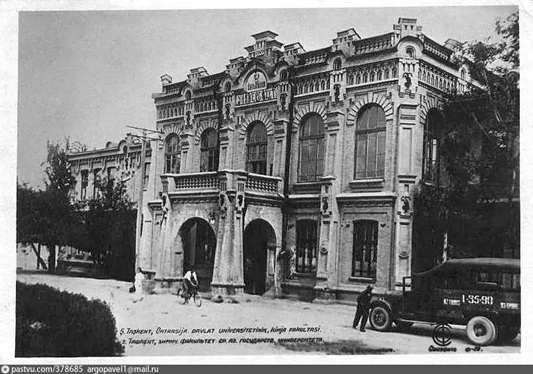
Higher education in Tashkent was started in 1918 from establishment of the National University, which was extended and renamed in 1920, resulting in appearance of Turkistan State University. A lot of scientists were transferred from the European part of Russia to develop this place, which faculties became a basis for separate applied institutes. In particular, in 1933 Central Asia Industrial Institute was started, which was later known as Central Asia Polytechnical University, and then Tashkent Polytechnical University. Chemical department in the University appeared in 1926.
Move up: Tashkent, the capital of Uzbekistan, was also considered as the main city of larger geographic area in Central Asia. This large region (sometimes named Turkistan, i.e. the land of Turks) included all the countries of Central Asia controlled by the Russian impire and later by the USSR. Applied science in Tashkent accents agriculture (especially cotton production and irrigation) and geological exploration.
Aleksandr L’vovich Markman (1891-1979) was 1914 graduate of Novorossiysk University, who left Odessa far before polarography was started there. Before WWII, he worked in various industrial places and technical Universities in StPetersburg (Petrograd), Moscow, and Krasnodar. This work was mostly related to food industry, and specifically to butter-based products. In 1944-1969, he headed the Dept of analytical chemistry in Central Asia Polytechnical Institute in Tashkent. Surprizingly, polarography formed an essential part of his research related to chemical analysis for food industry, and became a subject of his 1951 DSc thesis “Polarographic study of hydrogenization process in the binary mixtures of unsaturated compounds”. Basically, this work should be related to heterogeneous catalysis, but analysis played a crucial role in its experimental part. An example of Markman’s organic polarography can be found in J. Gen. Chem. USSR <translation of Zhurnal Obshchei Khimii>. 1957. V. 27. P. 1512-1521. During his last decade, he headed the Dept of organic chemistry in Tver’ <Kalinin>.