Primary batteries
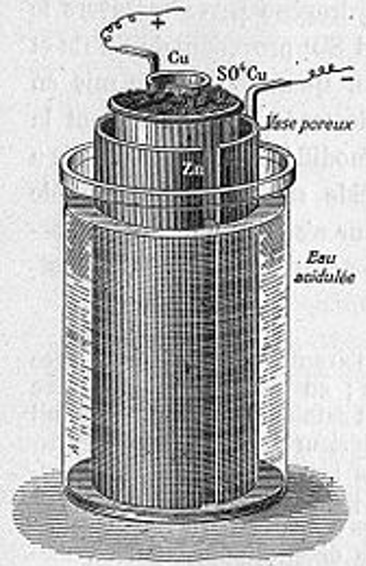
Daniell J.F. On Voltaic combinations // Phil. Trans. Royal Soc. London 1836. V. 126. P. 107-124. This is the letter of John Frederic Daniell (1790-1845) to Michael Faraday. A brief earlier publication is available in Phil. Mag. 1836. V. 8. P. 421-423. Further Daniell’s observations and battery improvements were published in a series of his letters to Faraday, Phil. Trans. Royal Soc. London 1836. V. 126. P. 125-129; 1837. V. 127. P. 141-160; 1838. V. 128. P. 41-56; 1839. V. 129. P. 89-95; 1842. V. 132. P. 137-155.
Daniell battery was quite workable (sometimes named “constant battery”). After a series of improvements by the author, it was used in early galvanics in 1840s, as well as for Dutch telegraph system in the beginning of 1850s.
Secondary batteries
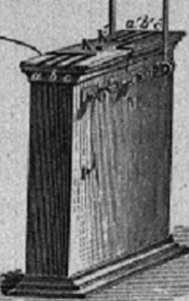
Planté G. Nouvelle pile secondaire d’une grande puissance // Compt Rend. Hebdomadaires Seances de l’Acad. Sci. Vie Academique 1860. V. 50. P. 640-642. This invention of Gaston Planté (1834-1889), acid-lead battery, is sometimes dated 1859, we still do not know how was this year documented.
Redox flow batteries
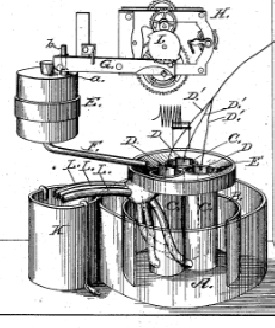
In 1879, John Doyle applied for the panent (granted in 1880) for Zn-Br2 primary battery operating under flow mode, with porous carbon electrodes <D in the picture> located at internal walls of the porous cylindric membranes <C> surrounded by Zn electrode <B>. Some other devices of this period are mentioned in reviews of Yu.V. Tolmachev (2023) and A.N. Nikoloski (2026).
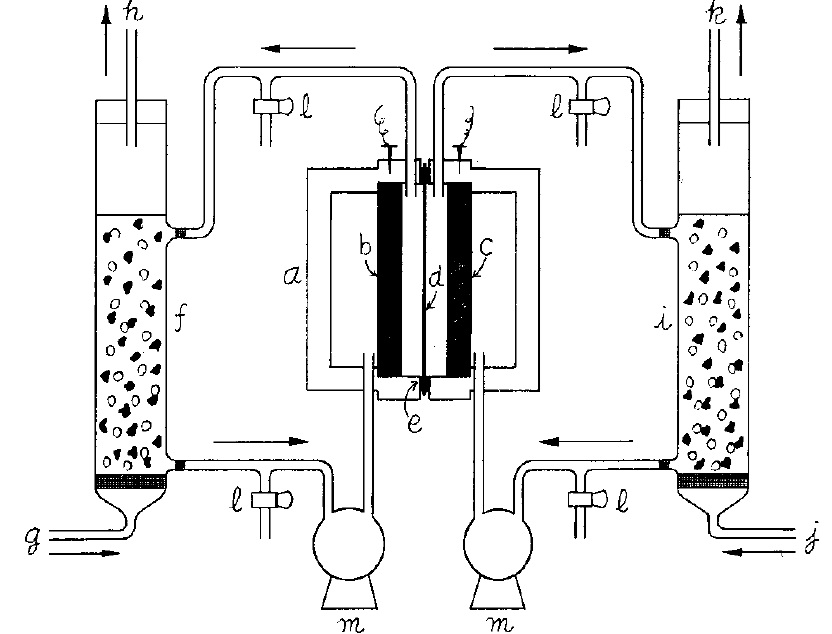
Walther Kangro (1889-1976) patented “Method for storing electrical energy” in 1949 (granted in 1954). This was already an idea of all-liquid redox flow battery. Many redox couples were proposed in this patent, including iron and chromium couples, which were found to be the most operative later.
In 1960s-1970s, a series of articles of Shinichi Ashimura and Yoshizo Miyake on “redox fuel cells” was published in Denki Kagaku oyobi Kogyo Butsuri Kagaku in Japanese, with abstracts and captions in English. Part 6 of this series 1971. V. 39. P. 944-948 is sometimes considered as a priority in respect to redox flow batteries, as it presents polarization data for flow-through porous carbon electrode. However, the complete cell appears only in Part 10 of the series 1976. V. 44. P. 46-51, the same year when the patent of Lawrence H. Thaller from NASA was granted (there are some NASA findings of 1973 documented by unpublished texts, see Refs in Tolmachev’s review). Very informative Japanese series consists of 12 parts, addressing Fe, Br, Ti, and Sn redox couples. Titles and DOI are listed in this file.