under construction
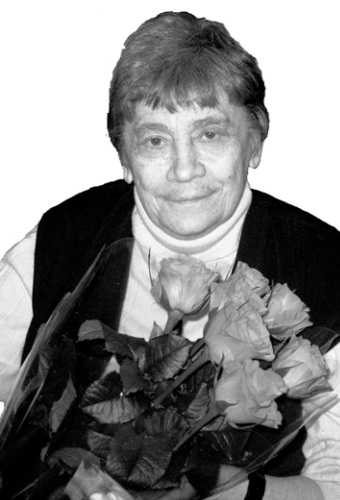
Ninel’ Mikhailovna Alpatova (1933-2014) joined the Institute in 1959, and started her work with Yuryi Mikhailovich Kessler (1924-2002), who was a solution chemistry person <he left the Institute in 1970, and his most known affiliation is the Institute of Solutions Chemistry in Ivanovo>. Her PhD (1965) addressed silicon compounds and anodic behavior of silicon in aprotic solvents. She also published with Kessler on the conductivity of non-aqueous solutions and on the solution behavior of aluminum compounds in aprotic media, including hexamethylphosphortriamide. This solvent was accented in her further systematic research jointly with L.I. Krishtalik (generation of solvated electrons) and A.V. Vannikov (spectroscopy of solvated electrons). Her DSc thesis (1982) is named “Electrode reactions of solvated electrons”. The development of these studies resulted in a series of works on solvation, especially for the model cobaltocene/cobaltocenium system. Starting from 1990s, she was dealing with electropolymerization, photoelectrochemistry of conducting polymers and relative organic materials.
Vladimir Ivanovich Bystrov was Krishtalik’s first PhD student (PhD 1967, thesis devoted to hydrogen evolution on silver). He was accepted from the Institute of Chlorine industry in 1964, and later returned to this institute, as one can judge from his publications of 1970s – early 1980s related to anodic processes on oxides.
Rudolf Georgievich Erenburg (1937-1997) PhD 1975 on chlorine evolution and ionisation kinetics
Larisa Aleksandrovna Khanova
Dina Vasilievna Kokoulina
Boris Borisovich Kuzmenko was PhD student who worked on hydrogen evolution on tungsten (1975 thesis). He later worked in the Institute of Power sources.
Galina Evgen’evna Titova, 1965 Moscow Univ. graduate, completed her diploma work with N.V. Fedorovich, and later worked on various Krishtalik’s research problems.
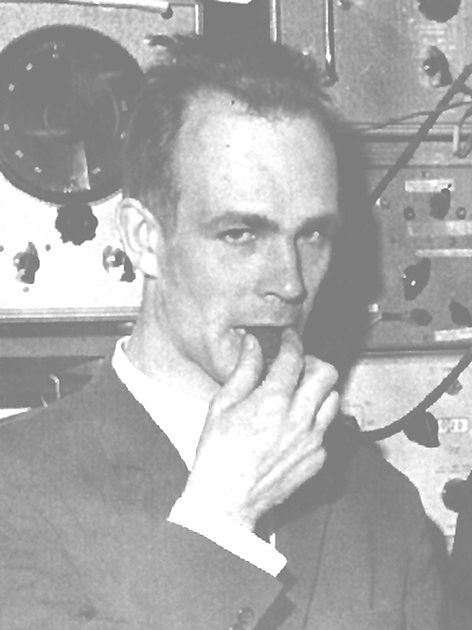
Viktor Vasilievich Topolev, 1967 graduate of Moscow University, started with O.A. Petrii. He studied ionic adsorption on platinum group metals (1974 PhD thesis), and then entered Krishtalik’s lab. For at least two decades, he was involved into the studies of electron transfer in protein/enzyme-based systems. He participated in Alpatova’s activities with conducting polymers, and in basic studies of solvation (estimates of a single ion transfer energy). Beyond science, Viktor’s poetic talent is widely known, which resulted in numerous excellent ironiс and even aphoristic rhymed lines.
Vladimir Mikhailovich Tsionsky His earliest article is co-authored with L.M. Yakimenko (1907-2003), a key electrolysis person in the Institute of Chlorine Industry. This article contains the data of tritium monitoring in Moscow rainfall in 1962-1963, with the use of electrolysis for isotope enrichment of the samples.