under construction
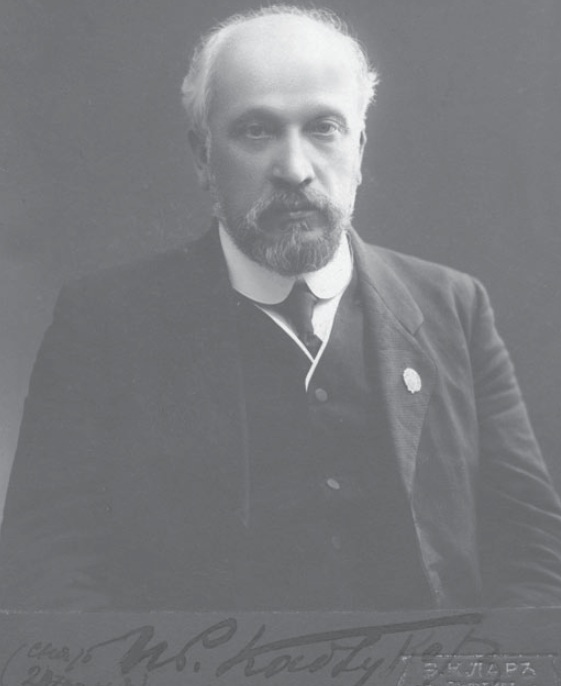
Ivan Alekseyevich Kablukov (1857-1942) graduated from Moscow University in 1880 and worked with Arrhenius and Ostwald in Leipzig for some period starting from 1889. His findings related to ‘anomalous conductivity’ of electrolyte solutions resulted in his 1891 Doctoral thesis (HCl solutions in ether and isoamyl alcohol). He was an active supporter of Arrhenius and Ostwald in their development of the concept of electrolytic dissociation (aggressively attacked by Mendeleev).
Kablukov’s text “In memoriam D.I. Mendeleeff” in Acta Physicochim. URSS. 1934. V. 1. P. 3-11 avoids the discussion of these contradictions and mostly accents the “periodic law”. The account of Mendeleev’s contribution to the solution studies is limited to his consideration of water-alcohol mixtures.
Kablukov’s early period (1879-1988) in Moscow and StPetersburg was devoted to organic chemistry (glycerins, his Magister thesis in 1887). His later work addressed various aspects of solution chemistry, including vapor-liquid equibria in water-alcohol binary systems and thermochemistry (also beyond solutions). In XX century, he made a lot in the area of solid salt/solution equilibria in respect to applied problems of salt lakes and salt deposits. He is also known for his studies of honey and beeswax (beekeeping was his hobby). Many details can be found in 80th jubilee article in Izvestiya Akademii Nauk SSSR. 1938. No 1. P. 3-10 and in obituary in the same journal 1942. No 4. P. 181-184 written by A.F. Kapustinskyi.
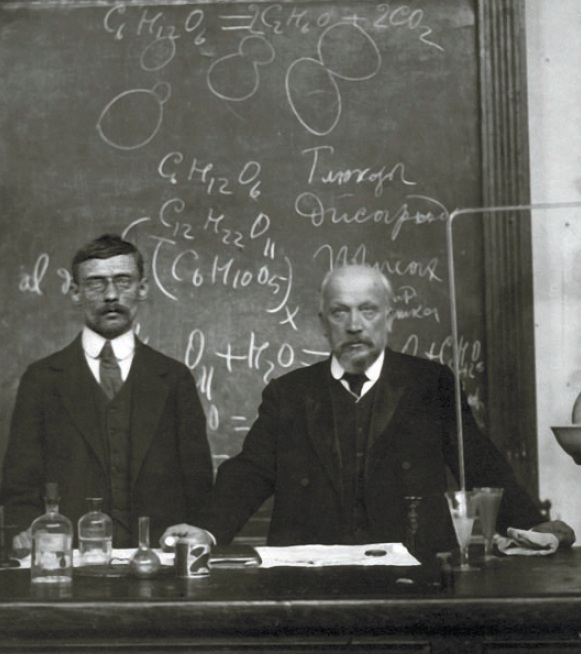
Kablukov was appointed as professor of Moscow University from 1903, and also teached in Agricaltural academy and several secondary schools. The photo shows him with A.D. Pavlovskyi, his lecture assistant. In 1918-1920, he visited Ivanovo once a week for teaching in local University.
Kablukov’s vividly written notes about his early period in Moscow University were published in Uspekhi Khimii. 1940. V. 9. P. 727-733, in Russian. This text shows how succession of synthetic chemistry schools generated pysical chemistry branches. Among Kablukov’s pupils, Aleksandr Nikolaevich Sakhanov (1886-1976) was the most direct scientific successor in respect to nonaqueous solutions. Kablukov’s diploma student (1922) was also Aleksanr Il’ich Brodsky (1895-1969), known for his studies of non-aqueous solutions in Dnepropetrovsk, close to L.V. Pisarzhevskyi, and later known for isotopes separation. Another Kablukov’s graduate (1929) known for his works in various fields of physical chemistry was Anatolyi Fedorovich Kapustinskyi (1906-1960). L.I. Krishtalik started his research work with Kapustinskyi.
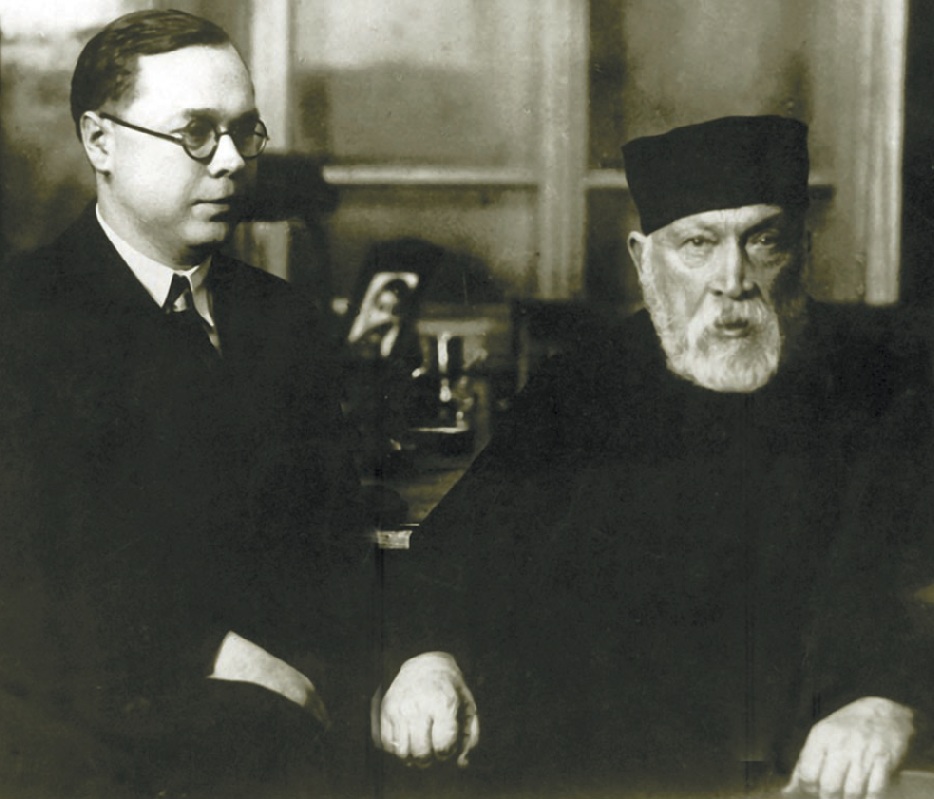
Viktor Ivanovich Spitsyn (1902-1988), left in the photo, also was Kablukov’s student, and started his rare-earth chemistry studies under his supervision.
Kablukov’s books in Russian available (2026) in the National electronic library:
Basic Foundations of Physical Chemistry, Pt. 1, 1900 (thermodynamics, liquids, solutions); also 1912 edition.
Basic Foundations of Physical Chemistry, Pt. 2, 1902 (electrochemistry); also 1922 edition.
Novel theories of atoms, 1908.
Phase rule, as applied to saturated solutions of salts, 1933.