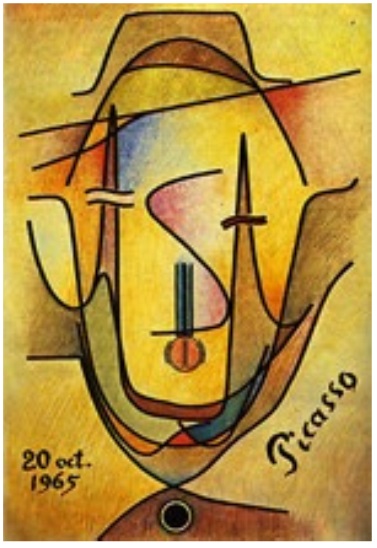
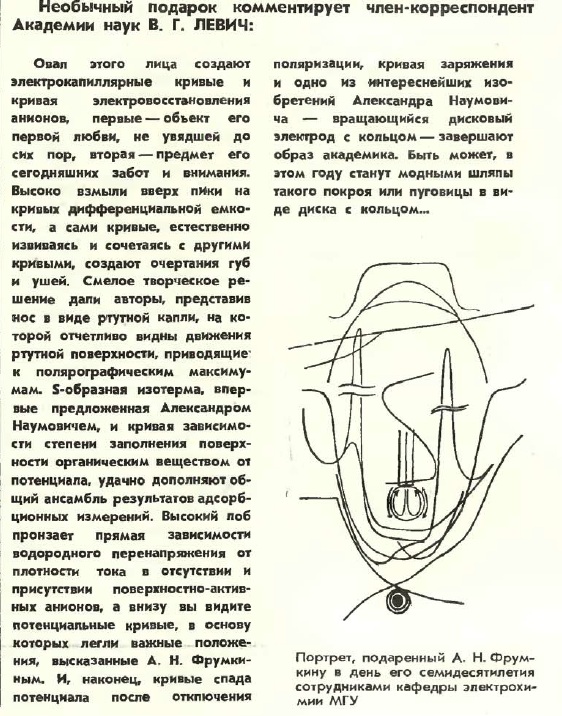
“Frumkin portrait by Picasso” (1965) designed by O.A. Petrii (1937-2021) and R. Marvet (1937-2002) as a gift for Frumkin’s 70th birthday. The following features go from mercury electrochemistry, symbolized by a capillary with a mercury drop in the center. Curves, from top to bottom: potential dependences of organic species adsorption (hat) and surface tension (crown of the head); Tafel plots for hydrogen evolution (wrinkle at the forehead); differential capacity curves, including sharp
peaks of organic species desorption with splits (eyes), surrounded by anionic pit (polarogram of anion electroreduction at the negatively charged surface); intersecting potential energy terms of reactant and product (chin). Features of platinum electrochemistry: lower part of the face is outlined by potential shift curve (from the right) and charging curve (from the left). Nose is formed by Frumkin isotherm (S-shaped, corresponding to high lateral attraction). Rotating ring disc electrode (as adornment at the neck) completes the image.
Levich’s comment to this portrait in Khimiya i Zhizn’. 1966. No 2. P.13.
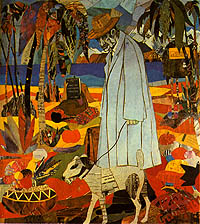
“Frumkin on the island of Tahiti” designed by Aleksey Anfimovich Lopatkin (1930-2004), who was a keenly intelligent expert in adsorption and art simultaneously. He was a good friend of The Dept of Electrochemistry for many years.
IFrumkin is walking with his fox terrier named Foma. Local lady in the back is reading “Kinetics of electrode processes” textbook. Lopatkin used incrustation by pieces of newspapers and magazines to create this masterpiece.