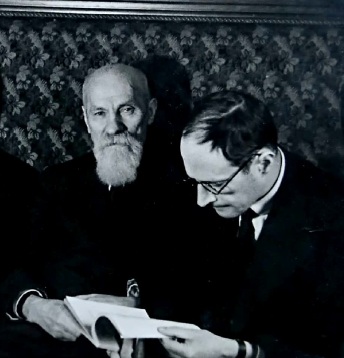
Some photos shown below are taken from the 1937 album presented to Aleksey Nikolaevich Bach (1857-1846) on the occasion of his 80th anniversary. Frumkin (to the right of Bach) served as a deputy director of the Institute, and also headed his lab of interfacial phenomena.
A.N. Bach played a crucial role in the foundation of Karpov Institute (first named the Central Chemical Laboratory) in 1918, and later as the director of this Institute. He had European research experience in biochemistry when returned to Russia in 1917, bein revolution sympathizer. He created the Institute of Biochemistry in Moscow as well. Here are 1946 Bach’s Obituaries in Acta Physicochim. URSS. 1946. V. 21. P. 385-386 (in English), in Izvestiya Akademii Nauk SSSR. 1946. No5. P. 465-466 (in Russian), and 1937 article about Bach’s contribution to biochemistry (P. 517-528, after jubilee texts, in Russian).
As for Karpov name, it belonged to the revolutioner Lev Yakovlevich Karpov (1879-1921) known for his contribution to organization of USSR chemical industry. Industrial motivation was a key point to create the Institute.
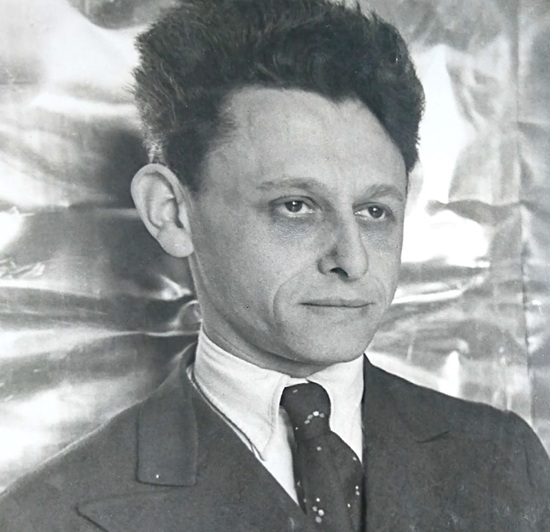
Moisei Yakovlevich Kagan (1895-1955) headed the lab of heterogeneous catalysis starting from 1929. His early work with Spitalskyi …… In 1940, he founded a Chair of chemistry and technology of the main organic synthesis in the Moscow Inst of Fine Chemical Technologies. ….
Isaak Abramovich Kazarnovskyi (1890-1981) headed the lab of inorganic chemistry. He graduated from Zurich Univ in 1914 and returned to Russia in 1917. A.N. Bach invited him to Karpov Institute to organize the lab of inorganic chemistry in 1922, simultaneously with inviting Frumkin. They both also launched teaching activities in Moscow Univ in 1930, and worked jointly on translating Arnold Eucken’s textbook. The first Kazarnovskyi’s research work was on electrochemistry of Te- and Se-based redox couples. In 1920s and early 1930s he also worked out a number of electrolytic technologies for metals recovery from various waste.
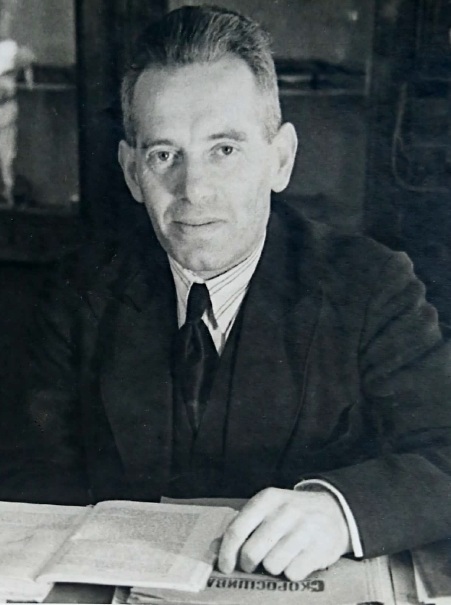
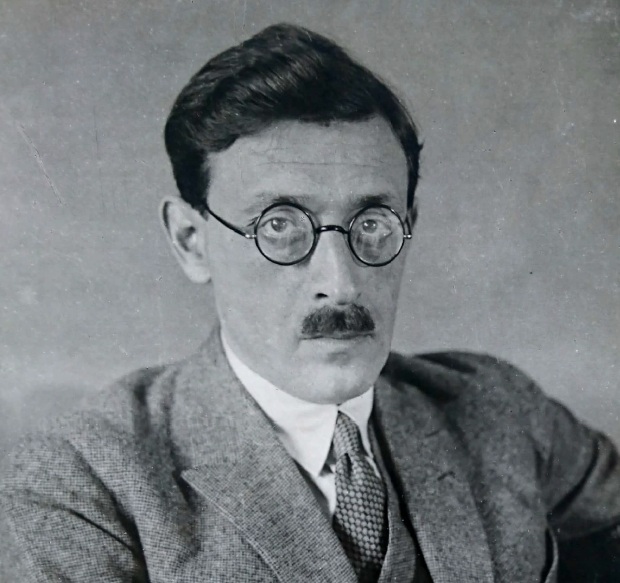
Adolf Iosifovich Rabinovich (1893-1942) <the link goes to detailed obituary article in Russian> originated from Odessa, graduated from Novorossiysk University in 1915, and taught physical chemistry in Odessa in 1917-1923. Then he moved to Moscow, and after three years in Karpov Inst became the head of the lab of colloid chemistry (1926). He pioneered applications of conductometry and potentiometry in colloid research. Later this lab was transformed into a large division. Rabinovich also created photochemistry lab in 1928, dealing with photography processes. Finally, in 1930 he also established the X-ray lab. He taught in Moscow University in 1930s (first photochemistry and structure of substances), and became a head of the Department of colloid chemistry in 1938. Under his supervision, the initial version of colloid practicum was created, further developed by P.I. Rehbinder later. Rabinovich also took part in translating Eucken’s textbook and extended it with necessary additions.
Valentin Alekseevich Kargin (1907-1969), head of the lab of high-molecular compounds, worked in Karpov Inst already in his studentship (as technical assistant), from 1924. He graduated from Moscow Univ in 1930 with the focus on colloid chemistry, and his research work in the lab of colloid chemistry of Karpov Institute started already in 1927. He was dealing with inorganic colloids (especially silicic acid), and also with cellulose. Kargin applied X-ray and electonograpy techniques to study cellulose fibers, and pioneered the physico-chemical polymer science. Kargin started his polymer lab in Karpov Institute in 1932, and founded the polymer department of Moscow University in 1955.
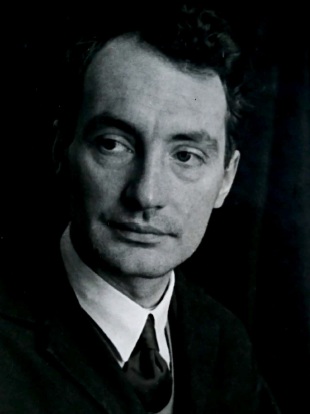
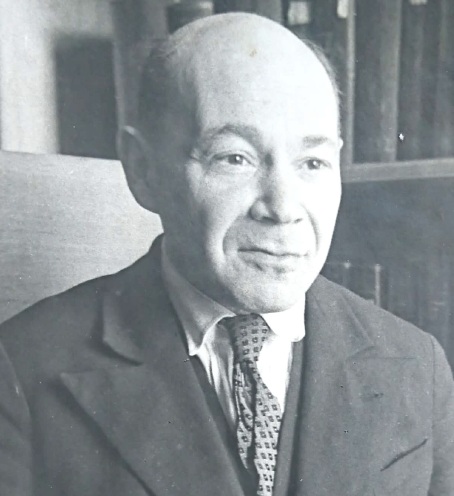
Alexander Matveyevich Monoszon [Monossohn] (1888-1968) started the lab of liquefied gases (sometimes named the lab of nonaqueous solvents) in Karpov Inst in 1928. The studies of liquid ammonia (and also some other systems being gaseous under normal conditions) were very important to extend a set of available solvents. Redox potentials, proton equilibria….. Pleskov…
Sergey Sergeyevich Medvedev (1891-1970) headed the lab of polymerization processes. He had pre-revolutionary education (Heidelberg Univ), and also graduated from Moscow Univ in 1918, working in industry in parallel with his classes. Medvedev started in Karpov Inst in 1922 after several years in Tashkent (Uzbekistan), where he took part in the foundation of Turkestan University. He studied kinetics of complex oxidation (formation of organic peroxides) and polymerization processes, which demonstrated manifestations of auto-catalysis and chain reactions and involved free radicals as intermediate species. Medvedev worked out various strategies, including catalytic and photo-assisted polymerization in various media, contributed to the controllable synthesis of co-polymers and of polymers with pre-defined molecular weight.
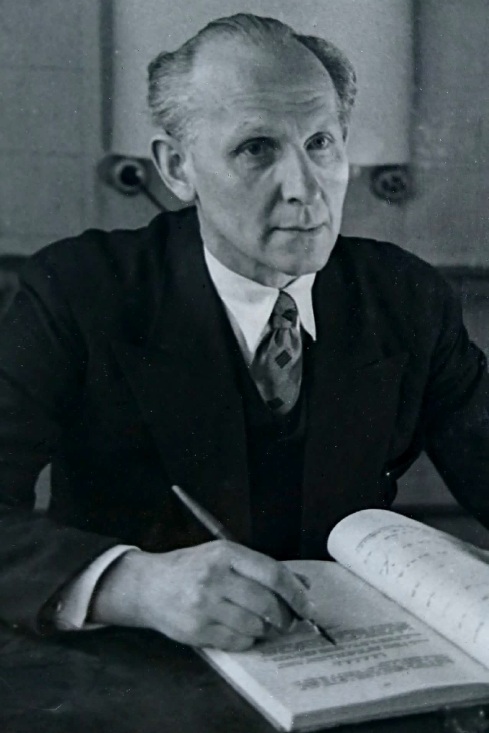
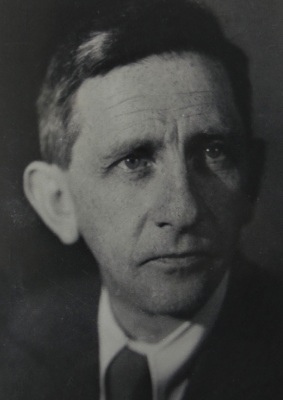
Yakov Kivovich Syrkin (1894-1974) started his work in Karpov Inst in 1932, after a period of teaching in Ivanovo, and headed the lab of molecular structure. He was initially educated in France (1912-1914), then in Riga Polytechnical Institute (since 1915, when this institute was evacuated to Moscow), and found himself in Ivanovo because Technological Institute was finally moved there. He was professor, and for some time the head of the chair of physical chemistry in Ivanovo, and then (from 1931) headed the chair in the Moscow Institute of Fine Chemical Technologies. In Karpov Institute, he set up the measurements of dipole moments and magnetic susceptibilities of various molecules, and applied these data to analyzing chemical bonding and reactivity. During the period of “the fight with cosmopolitans”, Syrkin and his collaborator Mirra Efimovna Dyatkina (1915-1972) were persecuted for their support of Pauling’s resonance theory, many details of this terrible story can be found in the study of A.A. Pechenkin. This 1944 Syrkin’s photo is from 2019 article of S.S. Plotkin et al., Fine Chemical Technologies. 2019. V. 14, No 6. P. 48-55.
This 1937 structure of Karpov Inst misses a number of divisions that existed earlier and were transferred to other institutions in the course of numerous reorganizations. Among them, the division of technical electrochemistry should be mentioned. Active members of this unit were Tatyana Grigor’evna Lyapuntsova (1898-?) and Frida Markovna Mars[c]hak (1897-?), both graduated from Moscow University. The head of the division was D.V. Stepanov, Izgaryshev’s graduate, whose fate and even the name remain unknown (his last publications with F.M. Marshak are dated 1935, and later he published on Ni deposition with the affiliation of the State Audio Record Laboratory up to 1941). Stepanov’s team in Karpov Institute was very successful in implementing galvanic technologies at industrial scale. It included Nikolay Dmitrievich Biryukov (1895-1972), who worked out chromium deposition technology in 1927 <the ink goes to his short bio in Russian>. His co-worker was Serafima Pavlovna Makar’eva, who later worked in Colloid-Electrochemical Inst. Another well-known representative of Izgaryshev’s school, Nikolay Tikhonovich Kudryavtsev (1901-1979), also worked in this lab in 1927-1930. In 1936, the unit of technical electrochemistry was transferred to the technologically oriented agency Elektrokhimmet containing Central electroplating laboratory.
Georgyi Leont’evich Stadnikov [Stadnikoff] (1880-1973), a prominent expert in charcoal and oil chemistry, moved to Moscow from Odessa, and founded the lab of charcoal chemistry in Karpov Inst. In 1928, in the course of reorganization, this lab was moved to the specialized institute of peat. Frimkin’s participation in some Stadnikov’s classes in Odessa is mentioned in the literature, and his studies of the adsorption on carbons were, at least partly, affected by Stadnikov’s research. Stadnikov was first arrested in 1920, and later in 1938. He spent 17 years in Vorkuta prisons and was released only in 1955. This 1938 photo is published by Yu.V. Evdoshenko, the author of a brief biographic article (in Russian) in Neftyanoe Khozyaistvo. 2015. No 2. P.109-112. Here is also a link to the recent article by S.A. Simakova (2024) with the list of most known Stadnikov’s publications.
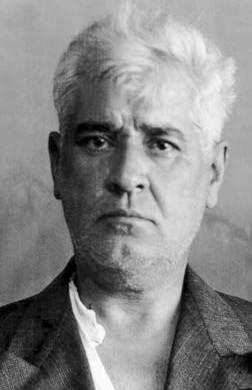
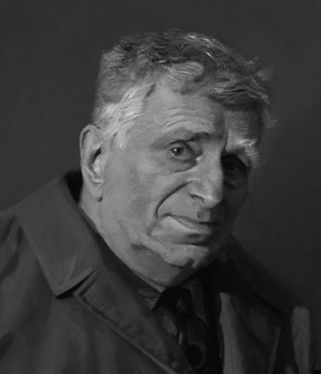
Another important person, Nikolay Albertovich Fuchs (1895-1982), is missing from Bach’s album because of his unjustified arrest in 1937. Fuchs was educated as a physicist, and headed the aerosol lab before 1937. He was able to return to Karpov Institute only after the formal amnesty in late 1950s, after staying out of Moscow for many years: first in Stalin’s camps, and later in various ‘secret institutions’ (after 1953, he could already work on his principle topic). He is internationally recognized for his works and books on mechanics of aerosols (see Reference list here).
Aleksandr Abramovich Zhukhovitskyi (1908-1990) Karpov Inst 1930-1948, them MISIS, chair of physical chemistry……
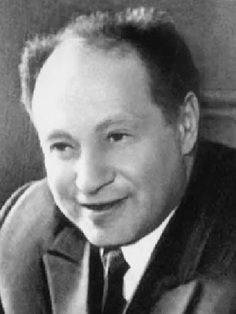
The presented structure of Karpov Inst also misses Mikhail Isaakovich Temkin as the head of chemical kinetics lab (started in 1938). Initially Temkin was affiliated with Syrkin’s lab.