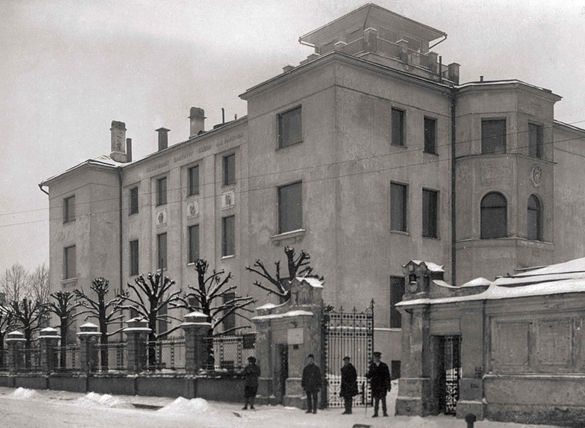
Karpov Institute, established in 1918, is famous for its location in Central Moscow, its architecture, and numerous scientific advancements of the past. When A.N. Frumkin moved to Moscow from Odessa in 1922, it was ideal for him to join this institute headed by biochemist Alexei N. Bakh. The first generation of Frumkin school was raised within these walls, where solid links were formed between the interfacial phenomena and electrochemical research in 1920s. Karpov Institute was well-known abroad, and was visited by western scientists regularly. E.g., the workshop on interfacial phenomena in Sept 1932 was visited by a dozen of the highest level experts, including M. Volmer, R.W. Gurney, and M. Polanyi. This was a year of Frumkin’s “Bemerkung zur Theorie der Wasserstoffüberspannung” publication.
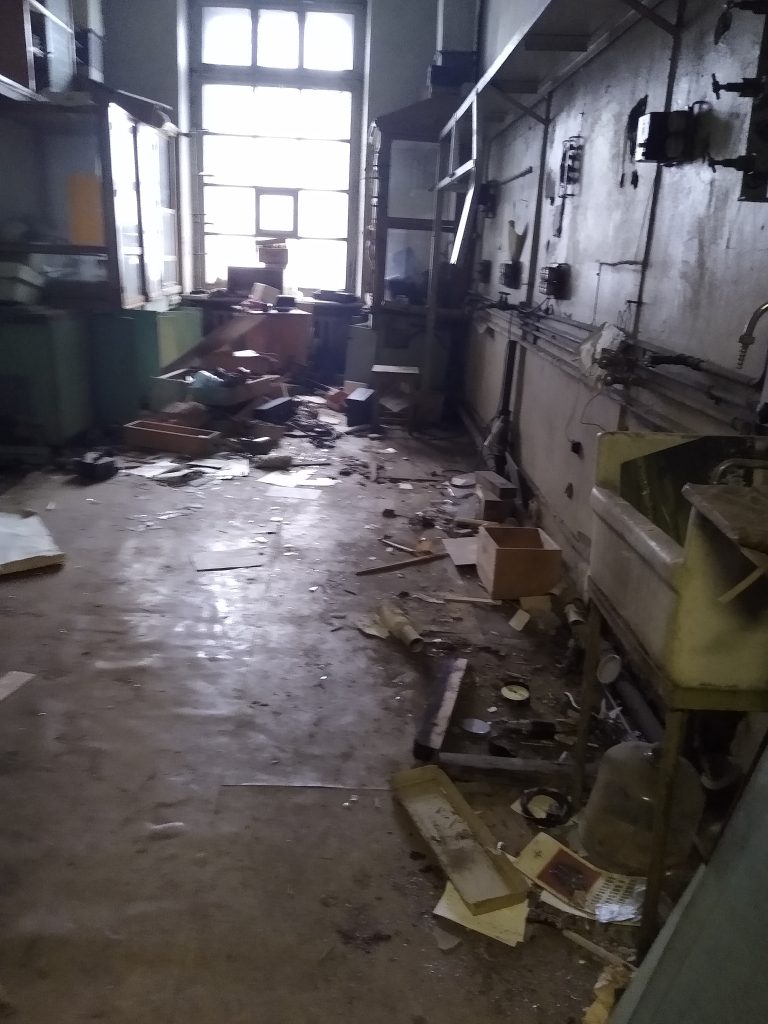
Currently, Karpov Institute is completely dissolved in Rosatom state agency, and its former laboratories are destroyed (this is a photo from February 2022). Archives are moved to an inaccessible place, the residual scientists are either retired, or hired by academic institutions. The destiny of Karpov Institute area (a large old park with several historical buildings) is hardly tied to science any more. We were lucky to study a small part of the archive documents before the devastating changes occurred.
Jubilee book of Karpov Institute, 1968 , in Russian
Selection of portraits of the leading scientists, early 1980s. These portraits were painted by Akhmed I. Kitaev (1925-1995) <probably from the photos> and posted in the library. When the library was shutted down, paintings were first moved to the last alive Institute building, and the books were moved to unheated barns. We were informed that everything, including archive, should be transferred to Rosatom place in Obninsk (Moscow region).
A less formal historiographer of Karpov Institute is Anatoly S. Sadovsky. His texts in Russian are scattered across the Internet, and certain details are not well documented, but there are many useful remarks and references.